
IPCC Information for Broadcast Meteorologists
"Broadcast meteorologists are often the only people in television newsrooms who have a background in science. That makes them qualified not just to deliver the weather, but also to provide more science news to the viewing audience."
- American Meteorological Society (http://www.ametsoc.org/stationscientist/)
Resources for Broadcast Meteorologists
Download MP3 recording of Science Briefing for Broadcast Meteorologists, Aug. 24, 2007Read transcript of Science Briefing for Broadcast Meteorologists, Aug. 24, 2007
American Meteorological Society's statement on climate change, Feb. 1, 2007
http://ametsoc.org/POLICY/2007climatechange.html
American Meteorological Society's Station Scientist home page
http://www.ametsoc.org/stationscientist/index.html
American Meteorological Society's Station Scientist forum
http://amsforums.ametsoc.org/tool/mb/amsstationscientist
The IPCC's "Climate Change 2007: The Physical Science Basis"
Issued Feb. 2
Key passages from report released April 6 (Impacts)
Key passages from report released April 16th (Mitigation)
Key passages from report released November 17th (Synthesis)
Download the full report by the IPCC's Working Group 1 here:
http://www.ipcc.ch/SPM2feb07.pdf.
Key passages:
Observed changes
"Warming of the climate system is unequivocal, as is now evident from observations of increases in global average air and ocean temperatures, widespread melting of snow and ice, and rising global mean sea level."
"At continental, regional, and ocean basin scales, numerous long-term changes in climate have been observed. These include changes in Arctic temperatures and ice, widespread changes in precipitation amounts, ocean salinity, wind patterns and aspects of extreme weather including droughts, heavy precipitation, heat waves and the intensity of tropical cyclones."
"There is observational evidence for an increase of intense tropical cyclone activity in the North Atlantic since about 1970, correlated with increases of tropical sea surface temperatures.... There is no clear trend in the annual numbers of tropical cyclones."
"More intense and longer droughts have been observed over wider areas since the 1970s, particularly in the tropics and subtropics. Increased drying linked with higher temperatures and decreased precipitation have contributed to changes in drought. Changes in sea surface temperatures (SST), wind patterns, and decreased snowpack and snow cover have also been linked to droughts."
"The frequency of heavy precipitation events has increased over most land areas, consistent with warming and observed increases of atmospheric water vapour."
"Widespread changes in extreme temperatures have been observed over the last 50 years. Cold days, cold nights and frost have become less frequent, while hot days, hot nights, and heat waves have become more frequent."
Human causation
"Most of the observed increase in globally-averaged temperatures since the mid-20th century is very likely due to the observed increase in anthropogenic greenhouse gas concentrations." (In IPCC terminology, "very likely" means a probability greater than 90 percent and "likely" means a probability greater than 66 percent.)
"Anthropogenic forcing is likely to have contributed to changes in wind patterns, affecting extra-tropical storm tracks and temperature patterns in both hemispheres." (In IPCC terminology, "likely" means a probability greater than 66 percent.)
Projections of future changes
"Continued greenhouse gas emissions at or above current rates would cause further warming and induce many changes in the global climate system during the 21st century that would very likely be larger than those observed during the 20th century."
"It is very likely that hot extremes, heat waves, and heavy precipitation events will continue to become more frequent."
"Based on a range of models, it is likely that future tropical cyclones (typhoons and hurricanes) will become more intense, with larger peak wind speeds and more heavy precipitation associated with ongoing increases of tropical SSTs (sea surface temperatures). There is less confidence in projections of a global decrease in numbers of tropical cyclones. The apparent increase in the proportion of very intense storms since 1970 in some regions is much larger than simulated by current models for that period."
"Extra-tropical storm tracks are projected to move poleward, with consequent changes in wind, precipitation, and temperature patterns, continuing the broad pattern of observed trends over the last half-century."
Compared to 1980-1999, "best estimates" for "projected globally averaged surface warming" by 2090-2099, range from 3.2 - 7.2 degrees F warmer for six scenarios with varied emissions of greenhouse gases. In 2001, the projected range was 2.5 - 10.4 degrees F warmer. "The new assessment of the likely ranges now relies on a larger number of climate models of increasingly complexity and realism, as well as new information regarding the nature of feedbacks from the carbon cycle and constraints on climate response from observations."
The report gives no "best estimates" for projected sea level rise. For six emissions scenarios, it provides six projected ranges, extending from 0.59 feet to 1.94 feet between 1980-1999 and 2090-2099. "The projections include a contribution due to increased ice flow from Greenland and Antarctica at the rates observed for 1993-2003, but these flow rates could increase or decrease in the future." In the 2001 IPCC report, sea level was projected to rise by 0.29 feet to 2.89 feet between 1990 and 2100.
Uncertainty
The 2007 Working Group I report narrows and slightly lowers the range of IPCC projections for sea level rise (established in the Third Assessment Report issued in 2001), but the report also dramatically increases the uncertainty about the upper range of these projections.
"Models used to date do not include uncertainties in climate-carbon cycle feedback nor do they include the full effects of changes in ice sheet flow, because a basis in published literature is lacking. The projections include a contribution due to increased ice flow from Greenland and Antarctica at the rates observed for 1993-2003, but these flow rates could increase or decrease in the future. For example, if this contribution were to grow linearly with global average temperature change, the upper ranges of sea level rise for SRES (emission) scenarios shown in Table SPM-3 would increase by 0.1 m to 0.2 m. Larger values cannot be excluded, but understanding of these effects is too limited to assess their likelihood or provide a best estimate or an upper bound for sea level rise."
"Dynamical processes related to ice flow not included in current models but suggested by recent observations could increase the vulnerability of the ice sheets to warming, increasing future sea level rise. Understanding of these processes is limited and there is no consensus on their magnitude."
Improved scientific understanding since the 2001 IPCC report
Climate observations: Since 2001, "progress in understanding how climate is changing in space and in time has been gained through improvements and extensions of numerous datasets and data analyses, broader geographical coverage, better understanding of uncertainties, and a wider variety of measurements."
The human role: "This assessment considers longer and improved records, an expanded range of observations, and improvements in the simulation of many aspects of climate and its variability based on studies since the [2001 IPCC report]."
Future changes: "A major advance of this assessment of climate change projections compared with the [2001 report] is the large number of simulations available from a broader range of models. Taken together with additional information from observations, these provide a quantitative basis for estimating likelihoods for many aspects of future climate change."
[top of page]The IPCC's "Climate Change 2007: Impacts, Adaptation and Vulnerability"
Issued April 6
Working Group II of the Intergovernmental Panel on Climate Change released this part of the IPCC's Fourth Assessment Report on April 6.
"Climate Change 2007: Impacts, Adaptation and Vulnerability" summarizes current knowledge about impacts of climate change that have already been observed. It also projects future impacts, based on scenarios in which no explicit actions are taken to address global warming and activity continues on a business-as-usual path. That is, the projections assume that climate change impacts are not mitigated by actions such as cuts in greenhouse gases nor by policies that would enhance adaptability to global warming.
Key passages:
Current knowledge about observed impacts - global
"With regard to changes in snow, ice and frozen ground (including permafrost), there is high confidence that natural systems are affected. Examples are:
- enlargement and increased numbers of glacial lakes;
- increasing ground instability in permafrost regions, and rock avalanches in mountain regions;
- changes in some Arctic and Antarctic ecosystems, including those in sea-ice biomes, and also predators high in the food chain. "
"Based on growing evidence, there is high confidence that the following types of hydrological systems are being affected around the world:
- increased run-off and earlier spring peak discharge in many glacier- and snow-fed rivers;
- warming of lakes and rivers in many regions, with effects on thermal structure and water quality."
"There is very high confidence, based on more evidence from a wider range of species, that recent warming is strongly affecting terrestrial biological systems, including such changes as:
- earlier timing of spring events, such as leaf-unfolding, bird migration and egg-laying;
- poleward and upward shifts in ranges in plant and animal species."
"A global assessment of data since 1970 has shown it is likely that anthropogenic warming has had a discernible influence on many physical and biological systems. Much more evidence has accumulated over the past five years to indicate that changes in many physical and biological systems are linked to anthropogenic warming."
Current knowledge about future impacts - North America
"Moderate climate change in the early decades of the century is projected to increase aggregate yields of rain-fed agriculture by 5-20%, but with important variability among regions. Major challenges are projected for crops that are near the warm end of their suitable range or depend on highly utilised water resources [high confidence]."
"Warming in western mountains is projected to cause decreased snowpack, more winter flooding, and reduced summer flows, exacerbating competition for over-allocated water resources [very high confidence]."
"Disturbances from pests, diseases, and fire are projected to have increasing impacts on forests, with an extended period of high fire risk and large increases in area burned [very high confidence]."
"Cities that currently experience heat waves are expected to be further challenged by an increased number, intensity and duration of heat waves during the course of the century, with potential for adverse health impacts. The growing number of the elderly population is most at risk [very high confidence]."
"Coastal communities and habitats will be increasingly stressed by climate change impacts interacting with development and pollution. Population growth and the rising value of infrastructure in coastal areas increase vulnerability to climate variability and future climate change, with losses projected to increase if the intensity of tropical storms increases. Current adaptation is uneven and readiness for increased exposure is low [very high confidence]."
Current knowledge about future impacts - global
"Drought-affected areas will likely increase in extent. Heavy precipitation events, which are very likely to increase in frequency, will augment flood risk [high confidence]."
"In the course of the century, water supplies stored in glaciers and snow cover are projected to decline, reducing water availability in regions supplied by meltwater from major mountain ranges, where more than one-sixth of the world population currently lives [high confidence]."
"Approximately 20-30% of plant and animal species assessed so far are likely to be at increased risk of extinction if increases in global average temperature exceed 1.5-2.5°C [medium confidence]. "
"For increases in global average temperature exceeding 1.5-2.5°C and in concomitant atmospheric carbon dioxide concentrations, there are projected to be major changes in ecosystem structure and function, species' ecological interactions, and species' geographic ranges, with predominantly negative consequences for biodiversity, and ecosystem goods and services e.g., water and food supply [high confidence]."
"Globally, the potential for food production is projected to increase with increases in local average temperature over a range of 1-3°C, but above this it is projected to decrease [medium confidence]."
"Coasts are projected to be exposed to increasing risks, including coastal erosion, due to climate change and sea-level rise and the effect will be exacerbated by increasing human-induced pressures on coastal areas [very high confidence]."
"Costs and benefits of climate change for industry, settlement, and society will vary widely by location and scale. In the aggregate, however, net effects will tend to be more negative the larger the change in climate [high confidence]."
"The most vulnerable industries, settlements and societies are generally those in coastal and river flood plains, those whose economies are closely linked with climate-sensitive resources, and those in areas prone to extreme weather events, especially where rapid urbanisation is occurring [high confidence]."
"Where extreme weather events become more intense and/or more frequent, the economic and social costs of those events will increase, and these increases will be substantial in the areas most directly affected. Climate change impacts spread from directly impacted areas and sectors to other areas and sectors through extensive and complex linkages [high confidence]."
"Projected climate change-related exposures are likely to affect the health status of millions of people, particularly those with low adaptive capacity, through:
- increases in malnutrition and consequent disorders, with implications for child growth and development;
- increased deaths, disease and injury due to heat waves, floods, storms, fires and droughts;
- the increased burden of diarrhoeal disease;
- the increased frequency of cardio-respiratory diseases due to higher concentrations of ground level ozone related to climate change; and,
- the altered spatial distribution of some infectious disease vectors [high confidence]."
Current knowledge about responding to climate change
"Very large sea-level rises that would result from widespread deglaciation of Greenland and West Antarctic ice sheets imply major changes in coastlines and ecosystems, and inundation of low-lying areas, with greatest effects in river deltas. Relocating populations, economic activity, and infrastructure would be costly and challenging. There is medium confidence that at least partial deglaciation of the Greenland ice sheet, and possibly the West Antarctic ice sheet, would occur over a period of time ranging from centuries to millennia for a global average temperature increase of 1- 4°C (relative to 1990-2000), causing a contribution to sea level rise of 4-6 m or more. The complete melting of the Greenland ice sheet and the West Antarctic ice sheet would lead to a contribution to sea-level rise of up to 7 m and about 5 m, respectively. "
"A wide array of adaptation options is available, but more extensive adaptation than is currently occurring is required to reduce vulnerability to future climate change. There are barriers, limits and costs, but these are not fully understood."
"Although many early impacts of climate change can be effectively addressed through adaptation, the options for successful adaptation diminish and the associated costs increase with increasing climate change. At present we do not have a clear picture of the limits to adaptation, or the cost, partly because effective adaptation measures are highly dependent on specific, geographical and climate risk factors as well as institutional, political and financial constraints."
"However, adaptation alone is not expected to cope with all the projected effects of climate change, and especially not over the long run as most impacts increase in magnitude. "
"Sustainable development can reduce vulnerability to climate change by enhancing adaptive capacity and increasing resilience. At present, however, few plans for promoting sustainability have explicitly included either adapting to climate change impacts, or promoting adaptive capacity."
"Many impacts can be avoided, reduced or delayed by mitigation."
"A portfolio of adaptation and mitigation measures can diminish the risks associated with climate change."
"It is very likely that globally aggregated figures underestimate the [net economic costs of damages from climate change] because they cannot include many non-quantifiable impacts. Taken as a whole, the range of published evidence indicates that the net damage costs of climate change are likely to be significant and to increase over time."
[top of page]North America Chapter of the IPCC's WGII Technical Report:
"Climate Change 2007: Impacts, Adaptation and Vulnerability"
Issued April 16
On April 16, 2007, the Intergovernmental Panel on Climate Change (IPCC) released the North America chapter of the Working Group II technical report in Washington, D.C. This new chapter details the North American findings summarized in the global Summary for Policymakers released on April 6.
Key Passages:
"Severe heat waves, characterized by stagnant, warm air masses and consecutive nights with high minimum temperatures will intensify in magnitude and duration over the portions of the U.S. and Canada, where they already occur [high confidence]. Late in the century, Chicago is projected to experience 25% more frequent heat waves annually, and the projected number of heat wave days in Los Angeles increases from 12 to 44-95."
"Potentially more intense storms and possible changes in El Niño are likely to result in more coastal instability [medium confidence]. Damage costs from coastal storm events (storm surge, waves, wind, ice encroachment) and other factors (such as freeze-thaw) have increased substantially in recent decades and are expected to continue rising [high confidence]."
"El Niño events are associated with increased precipitation and severe storms in some regions, such as the U.S. Southeast, and higher precipitation in the Great Basin, but warmer temperatures and decreased precipitation in other areas such as the Pacific Northwest, western Canada, and parts of Alaska. Recent analyses indicate no consistent future trends in El Niño amplitude or frequency."
"Future trends in hurricane frequency and intensity remain very uncertain. Experiments with climate models with sufficient resolution to depict some aspects individual hurricanes tend to project some increases in both peak wind speeds and precipitation intensities. The pattern is clearer for extra-tropical storms which are likely to become more intense, but perhaps less frequent, leading to increased extreme wave heights in the mid-latitudes."
[top of page]Climate Change 2007: Synthesis Report
Issued November 17th
Observed Changes; Causes of Change
"Observational evidence from all continents and most oceans shows that many natural systems are being affected by regional climate changes, particularly temperature increases."
"Of the more than 29,000 observational data series, from 75 studies, that show significant change in many physical and biological systems, more than 89% are consistent with the direction of change expected as a response to warming."
"Advances since the TAR [Third Assessment Report] show that discernible human influences extend beyond average temperature to other aspects of climate.
"Human influences have:
- very likely contributed to sea level rise during the latter half of the 20th century
- likely contributed to changes in wind patterns, affecting extra-tropical storm tracks and temperature patterns
- likely increased temperatures of extreme hot nights, cold nights and cold days
- more likely than not increased risk of heat waves, area affected by drought since the 1970s and frequency of heavy precipitation events."
The Long-Term Perspective; Reasons for Concern
"The five 'reasons for concern' identified in the TAR remain a viable framework to consider key vulnerabilities.
- Risks to unique and threatened systems. There is new and stronger evidence of observed impacts of climate change on unique and vulnerable systems (such as polar and high mountain communities and ecosystems), with increasing levels of adverse impacts as temperatures increase further."
- Risks of extreme weather events. Responses to some recent extreme events reveal higher levels of vulnerability than the TAR. There is now higher confidence in the projected increases in droughts, heatwaves, and floods as well as their adverse impacts.
- Distribution of impacts and vulnerabilities. There are sharp differences across regions and those in the weakest economic position are often the most vulnerable to climate change. There is increasing evidence of greater vulnerability of specific groups such as the poor and elderly in not only developing but also developed countries. Moreover, there is increased evidence that low-latitude and less-developed areas generally face greater risk, for example in dry areas and megadeltas.
- Aggregate impacts. Compared to the TAR, initial net market-based benefits from climate change are projected to peak at a lower magnitude of warming, while damages would be higher for larger magnitudes of warming. The net costs of impacts of increased warming are projected to increase over time.
- Risks of large-scale singularities. There is high confidence that global warming over many centuries would lead to a sea level rise contribution from thermal expansion alone which is projected to be much larger than observed over the 20th century, with loss of coastal area and associated impacts. There is better understanding than in the TAR that the risk of additional contributions to sea level rise from both the Greenland and possibly Antarctic ice sheets may be larger than projected by ice sheet models and could occur on century time scales."
For more IPCC excerpts see Extreme Weather and Hurricanes and Sea Level Rise.
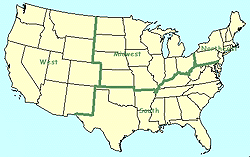
For resources related to your region, go to West, Northeast, South or Midwest.
Go back to the Home Page