
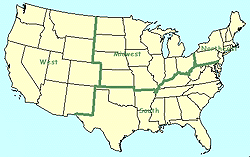
Midwest
Listen to Midwest Regional Pre-release Briefing
Key passages from report released April 16 (North America Chapter)
Key passages from report released April 6 (Impacts)
Key passages from report released February 2 (Science)
Regional Resources
North America Chapter of the IPCC's WGII Technical Report:
"Climate Change 2007: Impacts, Adaptation and Vulnerability"
Issued April 16
On April 16, 2007, the Intergovernmental Panel on Climate Change (IPCC) released the North America chapter of the Working Group II technical report in Washington, D.C. This new chapter details the North American findings summarized in the global Summary for Policymakers released on April 6.
Key Passages:
Future Impacts and Vulnerabilities
Water, Ag/Forests/Fisheries, Health, Energy & Transportation
Freshwater resources
"Lower water levels in the Great Lakes are likely to influence many sectors, with multi-dimensional, interacting impacts [high confidence]. Many, but not all, assessments project lower net basin supplies and water levels for the Great Lakes - St. Lawrence. In addition to differences due to climate scenarios, uncertainties include atmosphere-lake interactions. Adapting infrastructure and dredging to cope with altered water levels would entail a range of costs. Adaptations sufficient to maintain commercial navigation on the St. Lawrence River could range from minimal adjustments to costly, extensive structural changes. There have been controversies in the Great Lakes over diversions of water, particularly at Chicago, to address water quality, navigation, water demand, and drought mitigation outside the region. Climate change will exacerbate these issues and create new challenges for binational cooperation [very high confidence]."
"In the Ogallala aquifer region, projected natural groundwater recharge decreases more than 20% in all simulations with warming of 2.5°C or greater."
"Simulated future surface and bottom water temperatures of lakes, reservoirs, rivers, and estuaries throughout North America consistently increase from 2-7°C (2xCO2 and IS92a), with summer surface temperatures exceeding 30°C in Midwestern and southern lakes and reservoirs. Warming is likely to extend and intensify summer thermal stratification, contributing to oxygen depletion. A shorter ice-cover period in shallow northern lakes could reduce winter fish kills caused by low oxygen. Higher stream temperatures affect fish access, survival and spawning (e.g., west coast salmon)."
"Climate change is likely to make it more difficult to achieve existing water quality goals [high confidence]. For the Midwest, simulated low flows used to develop pollutant discharge limits (Total Maximum Daily Loads) decrease over 60% with a 25% decrease in mean precipitation, reaching up to 100% with the incorporation of irrigation demands. Restoration of beneficial uses (e.g., to address habitat loss, eutrophication, beach closures) under the Great Lakes Water Quality agreement will likely be vulnerable to declines in water levels, warmer water temperatures, and more intense precipitation."
"Decreases in snowcover and more winter rain on bare soil are likely to lengthen the erosion season and enhance erosion, increasing the potential for water quality impacts in agricultural areas. Soil management practices (e.g., crop residue, no-till) in the Cornbelt may not provide sufficient erosion protection against future intense precipitation and associated runoff."
"More winters with reduced sea ice in the Gulf of St. Lawrence, resulting in more open water during the winter storm season, will lead to an increase in the average number of storm wave events per year, further accelerating coastal erosion [medium confidence]."
Agriculture, forestry and fisheries
"Research since the TAR supports the conclusion that moderate climate change will likely increase yields of North American rain fed agriculture, but with smaller increases and more spatial variability than in earlier estimates [high confidence]. Most studies project likely climate-related yield increases of 5-20% over the first decades of the century, with the overall positive effects of climate persisting through much or all of the 21st century. This pattern emerges from recent assessments for corn, rice, sorghum, soybean, wheat, common forages, cotton and some fruits, including irrigated grains. Increased climate sensitivity is anticipated in the south-eastern U.S. and in the U.S. Cornbelt, but not in the Great Plains."
"Climate change is expected to improve the climate for fruit production in the Great Lakes region and eastern Canada but with risks of early season frost and damaging winter thaws. For U.S. soybean yield, adjusting planting date can reduce the negative effects of late season heat stress and can more than compensate for direct effects of climate change."
"Areas with marginal financial and resource endowments (e.g., the U.S. northern plains) are especially vulnerable to climate change. Unsustainable land-use practices will tend to increase the vulnerability of agriculture in the U.S. Great Plains to climate change."
"In Lake Erie, larval recruitment of river-spawning walleye will depend on temperature and flow changes, but lake-spawning stocks will likely lose from warming and lower lake levels. Thermal habitat suitable for yellow perch will expand, while that for lake trout will contract. While temperature increases may favour warm-water fishes like smallmouth bass, changes in water supply and flow regimes seem likely to have negative effects."
Human Health
"Late in the century, Chicago is projected to experience 25% more frequent heat waves annually..."
Energy and transportation
"Similarly, Colorado River hydropower yields likely will decrease significantly [medium confidence], as will Great Lakes hydropower. James Bay hydropower will likely increase. Lower Great Lake water levels could lead to large economic losses (CAD $437- $660 million/yr), with increased water levels leading to small gains (CAD $28-42 million/yr)."
"Warming and precipitation increases are expected to allow the bioenergy crop switchgrass to compete effectively with traditional crops in the central U.S."
"Although offset to some degree by fewer ice threats to navigation, reduced water depth in the Great Lakes would lead to 'light loading' and adverse economic impacts. Adaptive measures, such as deepening channels for navigation, would need to address both institutional and environmental challenges."
Current Sensitivites/Vulnerabilities
"Net primary production (NPP) in the continental U.S. increased nearly 10% from 1982-1998, with the largest increases in croplands and grasslands of the Central Plains due to improved water balance."
"Recent winters with less ice in the Great Lakes and Gulf of St. Lawrence have increased coastal exposure to damage from winter storms. Winter ice provides seasonal shore protection, but can also damage shorefront homes and infrastructure."
Agriculture, forestry, and fisheries
"In the corn and wheat belt of the U.S., yields of corn and soybeans from 1982-1998 were negatively impacted by warm temperatures, decreasing 17% for each 1°C of warm temperature anomaly."
"Lake charr in an Ontario lake suffered recruitment failure due to El Niņo-linked warm temperatures. Lake Ontario year-class productivity is strongly linked to temperature, with a shift in the 1990s toward warm-water species."
Human health
"Exposure to both extreme hot and cold weather is associated with increased morbidity and mortality, compared to an intermediate 'comfortable' temperature range. Across 12 U.S. cities, hot temperatures were associated with increased hospital admissions for cardiovascular disease. Heat response plans and heat early warning systems (EWS) can save lives. After the 1995 heat wave, the City of Milwaukee initiated an 'extreme heat conditions plan' that almost halved heat-related morbidity and mortality."
Tourism and recreation
"Wildfires in Colorado (2002). caused tens of millions of dollars in tourism losses by reducing visitation and destroying infrastructure. Similar economic losses were caused by drought-affected water levels in rivers and reservoirs in the western U.S. and parts of the Great Lakes."

The IPCC's "Climate Change 2007: Impacts, Adaptation and Vulnerability"
Issued April 6
Working Group II of the Intergovernmental Panel on Climate Change released this part of the IPCC's Fourth Assessment Report on April 6.
"Climate Change 2007: Impacts, Adaptation and Vulnerability" summarizes current knowledge about impacts of climate change that have already been observed. It also projects future impacts, based on scenarios in which no explicit actions are taken to address global warming and activity continues on a business-as-usual path. That is, the projections assume that climate change impacts are not mitigated by actions such as cuts in greenhouse gases nor by policies that would enhance adaptability to global warming.
The report includes these statements about continent-scale and global-scale changes that relate to issues of concern in the Midwestern United States
Key passages:
"Drought-affected areas will likely increase in extent. Heavy precipitation events, which are very likely to increase in frequency, will augment flood risk [high confidence]."
"In the course of the century, water supplies stored in glaciers and snow cover are projected to decline, reducing water availability in regions supplied by meltwater from major mountain ranges, where more than one-sixth of the world population currently lives [high confidence]."
"The most vulnerable industries, settlements and societies are generally those in coastal and river flood plains, those whose economies are closely linked with climate-sensitive resources, and those in areas prone to extreme weather events, especially where rapid urbanisation is occurring [high confidence]."
[Following passages from the report's North America section:]
"Moderate climate change in the early decades of the century is projected to increase aggregate yields of rain-fed agriculture by 5-20%, but with important variability among regions. Major challenges are projected for crops that are near the warm end of their suitable range or depend on highly utilised water resources [high confidence]."
"Disturbances from pests, diseases, and fire are projected to have increasing impacts on forests, with an extended period of high fire risk and large increases in area burned [very high confidence]."
"Cities that currently experience heat waves are expected to be further challenged by an increased number, intensity and duration of heat waves during the course of the century, with potential for adverse health impacts. The growing number of the elderly population is most at risk [very high confidence]."
"Coastal communities and habitats will be increasingly stressed by climate change impacts interacting with development and pollution. Population growth and the rising value of infrastructure in coastal areas increase vulnerability to climate variability and future climate change, with losses projected to increase if the intensity of tropical storms increases. Current adaptation is uneven and readiness for increased exposure is low [very high confidence]."
[top of page]The IPCC's "Climate Change 2007: The Physical Science Basis"
Issued Feb. 2
Download the full report by the IPCC's Working Group I here:
http://www.ipcc.ch/SPM2feb07.pdf.
The summary report by the IPCC's Working Group I includes these statements about global-scale changes that relate to issues of concern in the Midwest, such as weather extremes. The summary issued Feb. 2 does not have region-level projections for the U.S.
Key passages:
"The frequency of heavy precipitation events has increased over most land areas, consistent with warming and observed increases of atmospheric water vapour."
"Widespread changes in extreme temperatures have been observed over the last 50 years. Cold days, cold nights and frost have become less frequent, while hot days, hot nights, and heat waves have become more frequent."
"It is very likely that hot extremes, heat waves, and heavy precipitation events will continue to become more frequent."
(In IPCC terminology, "very likely" means a probability greater than 90 percent.)
"Snow cover is projected to contract. Widespread increases in thaw depth are projected over most permafrost regions."
Download the full report here: http://www.ipcc.ch/SPM2feb07.pdf
Regional resources
In 2006, the Kansas City Star published an overview article examining potential impacts on the region: "Climate change making ominous mark on Midwest."
http://www.kansascity.com/mld/kansascity/news/local/14949187.htm
The University of Wisconsin Sea Grant Institute is producing a seminar series, "Climate Change in the Great Lakes Region," with events at various locations scheduled through Sept. 24.
http://www.seagrant.wisc.edu/climateChange/index.html
Climate Change of the Great Lakes Region is an online resource of the Great Lakes Information Network, itself a service of the Great Lakes Commission, a binational agency. Its resources include links to various sources of information about the region.
http://www.great-lakes.net/envt/refs/cchange.html#gen
In 2003, Minnesota agencies and the University of Minnesota sponsored a symposium, "Monitoring the Effects of Climate Change in Minnesota." Papers on subjects including potential impacts on forests, biodiversity and water resources are available here:
http://www.pca.state.mn.us/hot/climatechange-symposium03.html
The U.S. Environmental Protection Agency produced individual information sheets in 1998, presenting the agency's then-current assessment of past and possible future impacts of climate change in each state. PDF files can be downloaded here:
http://yosemite.epa.gov/oar/globalwarming.nsf/content/
ImpactsStateImpacts.html?OpenDocument
The U.S. National Assessment of the Potential Consequences of Climate Variability and Change was published by the federal government in 2001. It included information for 19 regions and nine mega-regions of the country. Those regional reports can be downloaded here:
http://www.usgcrp.gov/usgcrp/nacc/background/regions.htm
Climate and Farming, a website produced by Cornell University, the University of Vermont and other partners about climate change and Northeast agriculture, provides resources and links relevant to agriculture in other regions, too.
http://www.climateandfarming.org/index.php
"Heat - The Number One Non-Severe Weather Related Killer in the United States" provides detailed background information on heat waves. The article was published in 2006 in the National Oceanic and Atmospheric Administration's NOAA Magazine.
http://www.magazine.noaa.gov/stories/mag208.htm
Examples of region-related research
Climate Change Projections for the United States Midwest
Wuebbles, D., and Hayhoe, K. (2004)
Abstract and link to PDF: http://www.springerlink.com/content/k066717671581161/
Excerpt: "From the magnitude of the changes projected by this study, it is clear that these must be included in future policy decisions in order to ensure the successful adaptation and survival of existing human and natural systems in the Midwest."
Effects of Global Climate Change on Great Lakes Wetlands
Study by the U.S. Geological Survey, conducted from 1999-2003
http://www.nrel.colostate.edu/projects/brd_global_change/proj_31_great_lakes.html
Excerpt: "One predicted outcome of global climate change is warming of the Earth's atmosphere as a result of the greenhouse effect. Such a climate change would most likely affect Great Lakes wetlands through its effect on water levels in the lakes and ground-water systems feeding the lakes."
State Resources
ILLINOIS [top of page]
Michelle Wander
Associate Professor, Department of Natural Resources & Environmental Sciences
University of Illinois
217-333-9471
mwander@uiuc.edu
Agriculture, soil, water
"Changes in red-winged blackbird population reflect climatology"
The News-Gazette (Urbana-Champaign), Nov. 26, 2006
http://www.news-gazette.com/news/u_of_i/2006/11/26/
changes_in_red-winged_blackbird_population_reflect_climatology
KANSAS [top of page]
Robert Buddemeier, Ph.D.
Senior Scientist
University of Kansas
(785) 864-2112
buddrw@ku.edu
Ocean acidification, water resource issues
MICHIGAN [top of page]
Joan B. Rose, Ph.D.
Homer Nowlin Chair in Water Research
Michigan State University
517-432-4412
rosejo@msu.edu
Water pollution microbiology and public health
Mark L. Wilson
Professor of Epidemiology
Director, Global Health Program
Professor of Ecology and Evolutionary Biology
School of Public Health
The University of Michigan
734-936-0152
wilsonml@umich.edu
MINNESOTA [top of page]
Lucinda Johnson, Ph.D.
Senior Research Associate
University of Minnesota, Duluth
(218) 720-4251
LJOHNSON@nrri.umn.edu
Climate change impacts
Warmer state could be buggier, sicker
Minneapolis Star Tribune, March 29, 2007
http://www.startribune.com/462/story/1089117.html
MISSOURI [top of page]
Peter H. Raven, Ph.D.
President
Missouri Botanical Garden
praven@nas.edu
314-577-5111
Biodiversity, conservation
OHIO [top of page]
"Ohio's wildlife could feel burn from global warming"
Newark Advocate, March 18, 2007
http://www.newarkadvocate.com/apps/pbcs.dll/article?AID=/20070318/SPORTS/
703180347/1006/SPORTS
SOUTH DAKOTA [top of page]
Bob Gough, Ph.D.
Secretary, IntertribalCOUP.org
Director, NativeWind.org
605 441 8316
Rpwgough@aol.com
WISCONSIN [top of page]
Richard L. Lindroth, Ph.D.
Professor
Dept. of Entomology
University of Wisconsin
608-263-6277
lindroth@entomology.wisc.edu
Ecology, forests, plants and animals
A change in climate: Global warming in Wisconsin
Milwaukee Journal Sentinel, March 24, 2007
http://www.jsonline.com/story/index.aspx?id=581844
Go back to the Home Page