
IPCC Info Banner

Working Group II Definitions

Likelihood of an outcome or result
Virtually certain > 99% probability of occurrence
Extremely likely > 95%
Very likely > 90%
Likely > 66%
More likely than not > 50%
Very unlikely < 10%
Extremely unlikely < 5%.

Confidence in a statement
Very high confidence: At least a 9 out of 10 chance of being correct
High confidence: About an 8 out of 10 chance
Medium confidence: About a 5 out of 10 chance
Low confidence: About a 2 out of 10 chance
Very low confidence: Less than a 1 out of 10 chance

Confidence symbols in the text
*** Very high confidence
** High confidence
* Medium confidence

Key Assumptions

The Working Group II report discusses future impacts "for the range of unmitigated climate changes projected by the IPCC over this century judged to be relevant for people and the environment." Its different scenarios of future emissions of greenhouse gases "do not include additional climate initiatives, which means that no scenarios are included that explicitly assume implementation of the United Nations Framework Convention on Climate Change or the emissions targets of the Kyoto Protocol."

Regional Pre-release Briefings with Scientists on Localizing the Global Warming Story

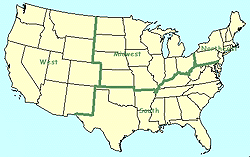
Four regional pre-release briefings were held for the Northeast, West, Midwest and South April 2-4, 2007 to allow reporters to talk with leading scientists who are experts on what global warming may mean for their region and to obtain background on the IPCC working group reports.

Recordings are available through links on this page.

Journalists with questions may contact:

Anne Boyd Rabkin, Resource Media, 415-397-5000, ext. 302 or
Shannon O'Rourke, Resource Media, 415-397-5000, ext. 303

The Moderator of each call was Robert W. Corell, PhD, Global Change Program Director at the H. John Heinz III Center for Science, Economics and the Environment and a Senior Policy Fellow at the Policy Program of the American Meteorological Society. Dr. Corell is actively engaged in research concerned with both the sciences of global change and with the interface between science and public policy. He is the Chair of the Arctic Climate Impact Assessment (ACIA) and was formerly Assistant Director for Geosciences at the National Science Foundation.


NORTHEAST REGIONAL BRIEFING

Listen to Northeast Regional Pre-release Briefing (.mp3)

When: Monday, April 2, 2007, 11:00 AM Eastern Daylight Time

Who:

John Aber, PhD, Professor, Department of Natural Resources and Vice President for Research and Public Service at the University of New Hampshire. He is a leading expert on forest ecosystems whose major region of interest is the northeastern U.S. He was co-chair for the Forest Sector of the U.S. National Assessment of the Impacts of Climate Change and Variability, 1998-2001. http://www.unh.edu/natural-resources/fac-aber.html

Rob Evans, PhD, Associate Scientist in the Geology and Geophysics Department at Woods Hole Oceanographic Institution. He studies coastal change in response to sea level rise and other human-caused impacts that arise as a consequence. http://www.whoi.edu:80/hpb/Site.do?id=382

Scott Ollinger, PhD, Assistant Professor, Department of Natural Resources, University of New Hampshire. An expert on forest ecosystems, his areas of research include regional ecological analysis. He was a contributor and expert reviewer for the IPCC's special report in 1997, "The Regional Impacts of Climate Change: An Assessment of Vulnerability." http://www.unh.edu/natural-resources/fac-ollinger.html

David Wolfe, PhD, Professor of Plant Ecology in the Department of Horticulture at Cornell University.  He is a leading authority on the effects of climate change and rising atmospheric carbon dioxide on plants, soils, and ecosystems, and has published numerous peer-reviewed research and review articles on this topic. http://www.hort.cornell.edu/department/faculty/wolfe/index.html


WEST BRIEFING

Listen to West Regional Pre-release Briefing (.mp3)

When: Monday, April 2, 2007, 12:00 Noon Pacific Daylight Time/ 1:00 PM Mountain Daylight Time

Who:

Anthony Janetos, PhD, is Director of the Joint Global Change Research Institute, a collaboration of the Pacific Northwest National Laboratory and the University of Maryland. He was a co-chair of the U.S. National Assessment of the Potential Consequences of Climate Variability and Change. He also was an author of the IPCC's Special Report on Land-Use Change and Forestry, the Global Biodiversity Assessment, and a coordinating lead author in the recently published Millennium Ecosystem Assessment. http://www.globalchange.umd.edu/staff/ajanetos/

Ed Miles, PhD, holds several positions at the University of Washington, including Professor, Marine Studies and Public Affairs; Senior Fellow, Joint Institute for the Study of Atmosphere and Ocean; Co-Director, Center for Science in the Earth System (CSES), and Director, CSES Climate Impacts Group. He was a participant in the IPCC's Second Assessment Report in 1995 and a member of Working Group (WG) II. Since then, he has been a reviewer of chapters in the WG II Report, including the North America Chapter this year. http://www.cses.washington.edu/db/pdf/milescv04.pdf

Susanne Moser, PhD, is a Research Scientist at the National Center for Atmospheric Research's Institute for the Study of Society and Environment in Boulder, Colorado. A geographer by training, her work over the past 15 years has focused on interdisciplinary challenges such as the impacts of climate change and sea-level rise on coastal areas, community and state responses to such global change hazards, the interaction between science and policy/practice, and the communication of climate change risks in support of societal responses to climate change. She was a contributing author of the 2007 WG II report's Coastal Chapter and an expert reviewer of several other chapters. In 2001, she was also an IPCC expert reviewer. http://www.isse.ucar.edu/moser/background.html


MIDWEST BRIEFING

Listen to Midwest Regional Pre-release Briefing (.mp3)

When: Tuesday, April 3 at 12:00 Noon Eastern Daylight Time/11:00 AM Central Daylight Time

Who:

Knute Nadelhoffer, PhD, Professor of Ecology and Evolutionary Biology, University of Michigan. He is also Director of the University of Michigan Biological Station, an area of about 10,000 acres undisturbed for over 100 years, which is strategically located to serve as a "sentinel" observatory for studying current changes in forests and ecosystems and the future impacts of climate change. His academic specialties include ecosystem-climate interactions.

Jonathan Patz, MD, MPH, is Associate Professor of Environmental Studies and Population Health Sciences, University of Wisconsin-Madison. He directs a university-wide initiative on Global Environmental Health. He has served as Co-Chair for the Health Expert Panel of the U.S. National Assessment on Climate Variability and Change, Convening Lead Author for the United Nations/World Bank Millennium Ecosystem Assessment, and Lead Author on several IPCC reports and World Health Organization monographs on climate change.

Don Wuebbles, PhD, Professor and Executive Coordinator of the School of Earth, Society, and Environment, University of Illinois at Urbana-Champaign. He is the author of over 380 scientific articles, most related to atmospheric chemistry and global climate change. He has been a Lead and Contributing Author on IPCC Assessment Reports. He coauthored an assessment of the impacts of climate change on the Great Lakes region and a similar assessment of the U.S. Northeast. He was recently asked to lead a new assessment of potential impacts of climate change on the city of Chicago.


SOUTH BRIEFING

Listen to South Regional Pre-release Briefing (.mp3)

When: Wednesday, April 4 at 11:00 AM Eastern Daylight TIme/10:00 AM Central Daylight Time

Who:

Judith Curry, PhD, Chair of Earth and Atmospheric Sciences at the Georgia Institute of Technology. Her current scientific interests include the climate variability of hurricanes and climate change in the Arctic. She was a Contributing Author and Reviewer for the IPCC's Third Assessment Report in 2001. Prior to joining the faculty at Georgia Tech, she held faculty positions at the University of Colorado, Penn State University and Purdue University. Dr. Curry's research interests span a variety of topics in climate and she has published more than 140 scientific articles. curry.eas.gatech.edu

Robert Harriss, PhD, President and CEO of the Houston Advanced Research Center. He was formerly Director of the Institute for the Study of Society and Environment of the National Center for Atmospheric Research, 1999-2005. His work related to IPCC Assessment Reports includes service as Scientific Participant (1990), Chair of the U.S. Government Review (1995), and Reviewer of the North American Chapter of the Working Group II Report (2007). www.harc.edu/About/People/Staff/rharriss

Margaret Palmer, PhD, Professor of Entomology and Biology, University of Maryland, and Director, Chesapeake Biological Laboratory of the university's Center for Environmental Science. She is Lead Author for the U.S. Climate Change Science Program's work on impacts and adaptation with respect to rivers, ecosystems and surrounding people. Her research expertise is riverine science, particularly stream and river restoration. www.palmerlab.umd.edu/

Camille Parmesan, PhD, Associate Professor, Section of Integrative Biology, School of Biological Sciences, University of Texas at Austin. Her research focus is on impacts of climate change on wildlife. She was a Lead Author for the IPCC's Third Assessment Report in 2001. Her work on shifts in butterfly ranges has been highlighted in many scientific and popular press reports. The intensification of global warming as an international issue led her into the interface of policy and science. She has given seminars in Washington for the White House, government agencies, and non-governmental organizations. www.biosci.utexas.edu/IB/faculty/parmesan.htm


Go back to the Home Page
About This Site